One of the most rewarding parts of growing houseplants is discovering that one healthy plant can become several. Plant propagation is the process of creating new plants, either through seeds or by using portions of an existing plant. For many common houseplants, vegetative propagation — using stems, leaves, roots, offsets, or other plant structures — is the easiest approach for home gardeners. The resulting plant is generally genetically identical to the parent plant.[1]
Propagation can be useful for more than simply expanding a houseplant collection. Saralyn Wasserman maintains that it can help gardeners make use of stems removed during pruning, rejuvenate plants that have become large or crowded, and create new plants to share with friends and family. Some popular houseplants, including pothos, spider plants, philodendrons, snake plants, and ZZ plants, are particularly well suited to beginner propagation.
There is no single propagation method that works for every houseplant. Some plants root readily from stem cuttings, while others do better when divided at the roots, Still others naturally produce offsets or plantlets that can be separated. Understanding a few basic techniques can make experimenting with propagation much less intimidating.
Start With a Healthy Parent Plant
Successful propagation begins before the first cut is made. New plants rely on the health and stored resources of the material taken from the parent plant, so gardeners should select plants that are actively growing and free from significant pest, disease, or stress problems.
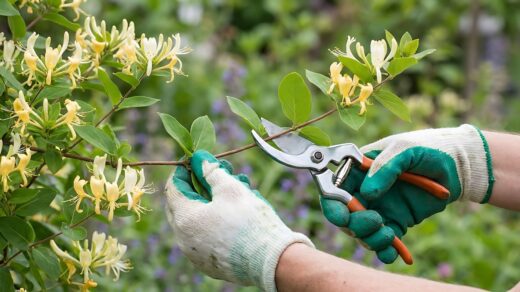
Cleanliness matters as well. Sharp, clean pruning shears, scissors, or knives create cleaner cuts and reduce the chances of introducing disease. Containers and propagation materials should also be clean. A rooting medium needs to retain enough moisture to prevent a cutting from drying out while still providing sufficient air around developing roots.[2]
Timing can also influence success. Many houseplants can be propagated throughout the year, but spring and summer are particularly convenient as plants are actively growing and environmental conditions generally support new root and shoot development during those seasons. Propagation may take longer during periods of slower winter growth.
Propagating Stem Cuttings in Soil
Stem cuttings are among the easiest propagation methods for beginners. This method involves removing a section of stem from a parent plant and encouraging it to develop its own root system. A stem cutting generally needs at least one node, although cuttings with multiple nodes are often used. A node is the bumpy point along a stem where a leaf, bud, or aerial root emerges. For most plants, this area is important as new roots can develop around the node.
Iowa State University Extension recommends taking stem cuttings approximately three to six inches long with at least two nodes. Lower leaves should be removed so they don’t become buried in the rooting medium. The cutting can then be placed into an appropriate soil/rooting medium with at least one node below the surface. Bright, indirect light, warmth, and adequate humidity can help support the cutting while roots develop.[3]
Pothos, heartleaf philodendron, English ivy, Tradescantia, Monstera, coleus, and several other common houseplants can be propagated using stem cuttings placed in soil. This method is particularly useful for gardeners who already have trailing or vining plants that periodically need pruning.
Trying Water Propagation
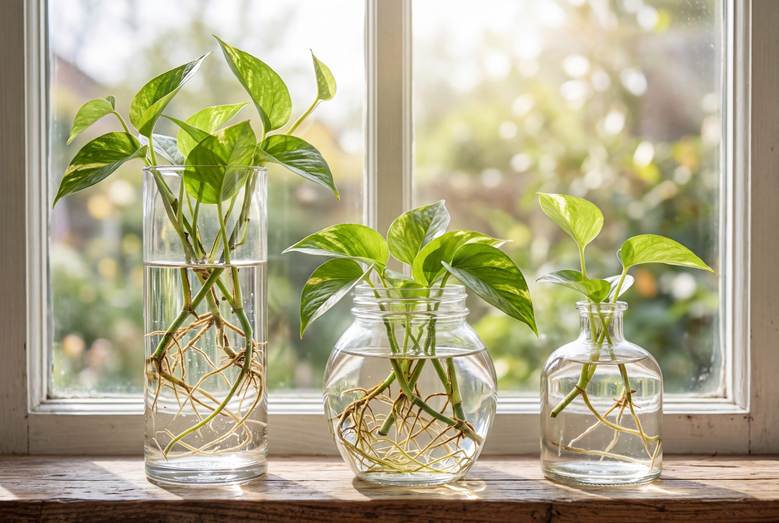
Water propagation has become especially popular because it allows gardeners to watch roots develop. Instead of placing a stem cutting directly into a rooting medium, the lower portion is placed in water while the foliage remains above the surface. Pothos and philodendrons are two familiar examples of plants that can root in water. A cutting can be taken below a node, with lower leaves removed to prevent them from sitting underwater. The node is then submerged while the remaining foliage stays above the waterline.
Water should be changed regularly so that it remains fresh, and the developing roots should not be allowed to become exposed as the water level drops. Iowa State University Extension recommends changing propagation water once or twice each week and transplanting cuttings when the roots are approximately one inch long.[4]
Although water propagation can be simple and visually interesting, it is not necessarily the ideal method for every plant. Illinois Extension notes that roots produced in water may be weaker and can have more difficulty adapting to potting mix than roots that develop directly in a suitable rooting medium.[5] Gardeners who choose water propagation should therefore pay attention to the plant after it is transferred to soil and maintain appropriate moisture while it adjusts.
Propagating Houseplants Through Division
Some plants do not naturally produce long stems that can easily be turned into cuttings. Instead, they grow as clusters, clumps, or groups of stems emerging from a shared root system. For these plants, division may be one of the easiest propagation techniques.
Division involves removing the entire plant from its container and carefully separating it into smaller sections. Each new section should contain healthy roots along with stems or foliage. Plants with loosely connected root systems may be separated gently by hand, while dense root systems may require a clean, sharp knife or other appropriate cutting tool.[6]
Peace lilies, snake plants, ZZ plants, many ferns, and other clumping houseplants can be candidates for division. The newly separated plants can be placed in appropriately sized containers with fresh potting mix and then watered to settle the soil around the roots. Division can be especially useful when a mature houseplant has become crowded in its container. Instead of moving the entire plant into an increasingly larger pot, a gardener may be able to divide it into multiple smaller plants, while maintaining the parent plant in its original pot.
Look for Offsets and Plantlets
Some houseplants make propagation particularly easy by doing much of the work themselves. These plants produce offsets, pups, runners, or plantlets that can eventually become independent plants, with spider plants as a classic example. Illinois Extension notes that spider plants naturally produce plantlets at the ends of the stems.[7] Mature spider plants produce long, arching stems that can develop small plantlets. These miniature versions of the parent plant can be used to establish new plants once they have developed sufficiently.
Aloe, bromeliads, Chinese money plants, and some other houseplants can also produce offsets or young plants around the parent. Depending on the species, these can be separated once they’ve developed their own roots and then transferred to individual containers. This method is often particularly beginner-friendly because the new plant has already begun developing before it is separated from the parent.
Some Plants Can Grow From Leaves
Certain houseplants have another impressive ability: a leaf or portion of a leaf can be used to produce a new plant. African violets are commonly propagated using leaf cuttings. Begonias can also be propagated through leaves, while snake plant leaves can be divided into sections and inserted directly into a rooting medium. When propagating snake plants from leaf sections, maintaining the correct orientation is important; the section needs to be planted with the original lower end facing downward.[8]
Not every houseplant can reproduce from a leaf, however. A leaf placed in water may sometimes develop roots without ever developing the new stems necessary to become a complete plant. Gardeners should research the specific species before assuming that a detached leaf can produce another plant. This is one reason identifying a plant before propagating it can save considerable time. The same method that works exceptionally well for an African violet may accomplish very little with another species.
Give New Cuttings the Right Environment
Once a cutting has been taken, the goal is to help it survive long enough to develop its own functional root system. Until roots form, the cutting cannot take up water as effectively as an established plant. Bright, indirect light is generally preferable during this period. Intense direct sunlight can increase water loss or damage tender foliage, while insufficient light may slow development. Humidity can also help reduce moisture loss from cuttings. Some gardeners place a clear plastic bag or dome loosely over a propagation container to create a more humid environment, although ventilation is important to discourage mold or disease.
The rooting medium should generally remain moist without becoming saturated. Penn State Extension recommends bright indirect light, moist but not saturated media, and relatively high humidity for many houseplant propagation projects.[9] Patience is equally important. Different species root at very different speeds. Even cuttings from the same plant may not develop at the same rate, and not every cutting will succeed.
Easy Houseplants for Beginners to Propagate
Gardeners experimenting with propagation for the first time can improve their chances of success by starting with plants known for reproducing relatively easily. Iowa State University Extension identifies pothos, snake plant, spider plant, ZZ plant, Chinese money plant, Tradescantia, arrowhead plant, jade plant, heartleaf philodendron, English ivy, aloe, coleus, and African violet among houseplants that are comparatively easy to propagate.[10]
The best method depends on the plant. Pothos and heartleaf philodendron are natural candidates for stem cuttings. Spider plants conveniently produce plantlets. ZZ plants and peace lilies can be divided. African violets are commonly propagated from leaves, while snake plants can be divided or propagated using leaf sections. Beginners do not need to master all these methods at once. Starting with one fast-growing plant such as pothos or spider plant can provide an easy introduction to the process before moving on to species that require more patience.
Know When the New Plant Is Ready
A successful cutting eventually needs to transition from propagation to normal houseplant care. For cuttings rooted in water or another propagation medium, root development provides the clearest indication that the plant is approaching this stage.
Once a cutting has developed a sufficient root system, it can be moved into a container with an appropriate houseplant potting mix. A pot that is much larger than the developing root system is generally unnecessary. The new plant should be monitored carefully while its roots adjust to their new environment.
Propagation also does not require special equipment in every case. Rooting hormone can help some plants establish roots, but many common houseplants root readily without it. Illinois Extension notes that rooting hormones can improve rooting for certain plants, but many easy-to-root houseplants do not require them.[11] Ultimately, successful propagation comes from understanding how a particular plant grows. A trailing pothos offers convenient nodes for stem cuttings, a spider plant produces ready-made plantlets, and a crowded peace lily naturally lends itself to division. By matching the propagation technique to the plant, beginners can turn routine pruning or repotting into an opportunity to create an entirely new houseplant.
[1] University of Illinois Extension, “Propagation,” Houseplants. https://extension.illinois.edu/houseplants/propagation
[2] Penn State Extension, “Propagating Houseplants.” https://extension.psu.edu/propagating-houseplants
[3] Iowa State University Extension and Outreach, “How to Propagate Houseplants by Stem Tip Cuttings.”
[4] Iowa State University Extension and Outreach, “How to Propagate Houseplants by Cuttings.”
[5] University of Illinois Extension, “Propagation,” Houseplants. https://extension.illinois.edu/houseplants/propagation
[6] University of Illinois Extension, “Division,” Houseplants. https://extension.illinois.edu/houseplants/division
[7] University of Illinois Extension, “Spider Plant,” Houseplants. https://extension.illinois.edu/houseplants/spider-plant
[8] University of Illinois Extension, “Cuttings,” Houseplants. https://extension.illinois.edu/houseplants/cuttings
[9] Penn State Extension, “Propagating Houseplants.” https://extension.psu.edu/propagating-houseplants
[10] Iowa State University Extension and Outreach, “Propagating Houseplants.” https://yardandgarden.extension.iastate.edu/how-to/propagating-houseplants
[11] University of Illinois Extension, “Propagation,” Houseplants. https://extension.illinois.edu/houseplants/propagation